One platform, built end to end — sensor, edge, cloud and dashboard.

Because we engineer both the hardware and the software, addaNet isn't a bundle of third-party parts hoping to talk to each other. It's a single, coherent stack designed for industrial sites in Africa — and for the equipment, networks and power realities they actually run on.

The architecture

Field device to dashboard — one stack, in-house.

1 · Sense

Field devices

addanode sensors plus your existing instruments, meters and PLCs

→
2 · Connect

Edge gateway

Reads PLCs, runs logic, buffers locally through load shedding

→
3 · Platform

addaNet

Ingest, store, model and secure — SA-region cloud or on-premise

→
4 · Act

Dashboards & alerts

Live views, WhatsApp/email alerts, scheduled reports

→
5 · Integrate

Business systems

ERP / MES via REST, OPC-UA and SQL

The dashboard end of the stack

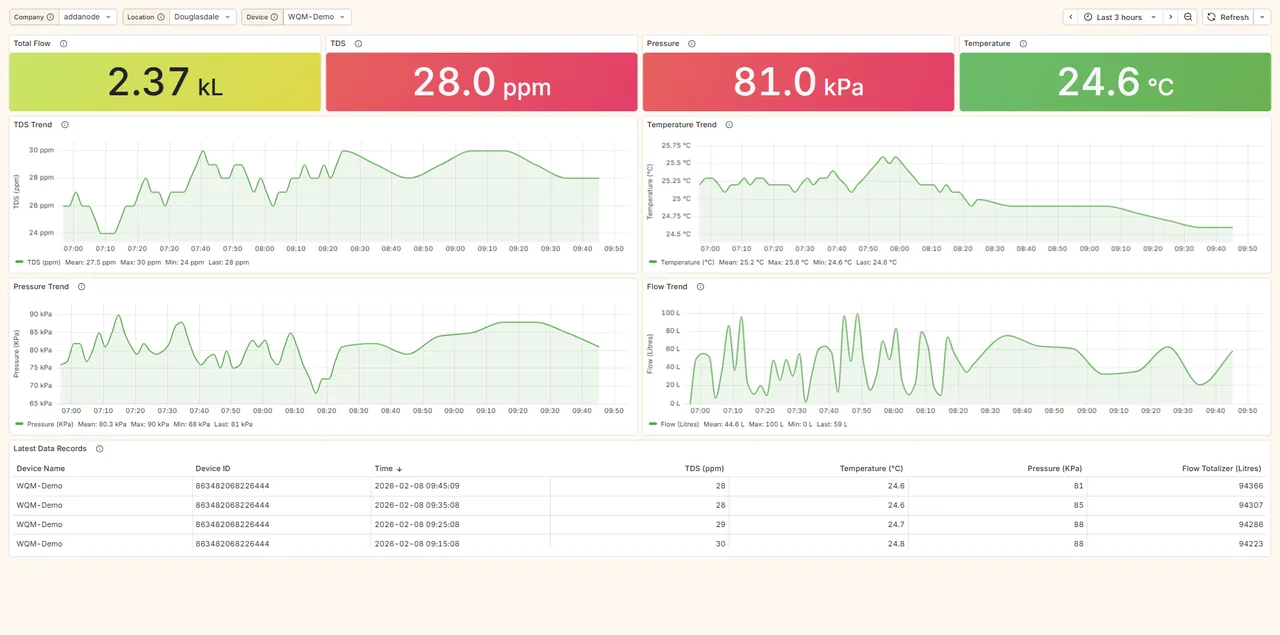
A real addaNet screen rather than a mock-up: a water-quality device on a demonstration line, with live values, three-hour trends and the raw record table — the same layout an OEE line, a borehole or a pump station gets, with its own parameters.

addaNet dashboard for a water quality monitoring device: total flow 2.37 kL, TDS 28 ppm, pressure 81 kPa, temperature 24.6 °C, with three-hour TDS, temperature, pressure and flow trends and the latest data records
addaNet water-quality dashboard on a demonstration line at our Douglasdale office: live TDS, flow, pressure and temperature, three-hour trends, and the record table behind them.
The hardware

addanode IoT hardware

addanode designs its field devices in-house — the N-series data terminals and the LoRa and LoRaWAN gateways and nodes — and the same team writes the addaNet platform they report into. That engineering goes back to 2016, first as Informed Decisions, and the team has deployed more than 120,000 devices since then. For PLCs and other complex systems, addanode supplies, configures and supports the IGR300 industrial gateway router.

FamilyModelsConnectivityUsed for
4G data terminalsN54GGeneral-purpose data acquisition at remote sites: analogue and digital inputs, meters and instruments
Water-quality terminalN5W4GWater-quality management, including the ADDAN5W smart water shop system
LoRa industrial gateway and nodesLoRa gateway, N2, N3LoRa (two-way industrial protocol)Cable-free coverage across a plant, mine or farm where running signal cable is impractical
LoRaWAN gateway and nodesNG gateway, N4LoRaWANWide-area, many-point deployments — see LoRaWAN site deployment
Industrial gateway routerIGR3004G, Wi-Fi, Ethernet, 4 × RS-485PLCs and complex systems: edge programming, VPN access, remote configuration and upgrades

The N-series terminals and the LoRa and LoRaWAN devices are designed by addanode; the IGR300 is supplied, configured and supported by addanode. Third-party sensors and existing PLCs are supported alongside all of them. For wide-area links we use LoRaWAN or 4G; LoRa, Wi-Fi and Ethernet carry data within a site.

IGR300 industrial gateway router
ItemIGR300
Power12 V DC
EthernetLAN and WAN ports; the WAN port can be reassigned as LAN
Cellular4G, with internal and external SIM options and a preferred-SIM switching strategy
Wi-FiHotspot and client modes at the same time, 2.4 GHz or 5 GHz
Serial4 × RS-485
Local I/OOn-board digital inputs and outputs, expandable with cascaded I/O modules
Local storageTF card or USB storage for on-device logging
Link failoverWired, Wi-Fi and cellular uplinks in priority order, with connectivity probing and automatic failover
VPN and remote accessL2TP/IPsec and OpenVPN clients; virtual networking with subnet proxy for remote access to on-site PLCs
Network securityFirewall traffic rules, port forwarding and static routes
Edge programmingNode-RED-based visual flows for data parsing, format conversion, edge logic and local control
ProtocolsModbus RTU and Modbus TCP, PLC and CNC protocols, IEC 60870-5-104, TCP, UDP, HTTP and MQTT
Remote managementRemote configuration, remote programming, remote LAN access and remote firmware upgrades

Which protocols can addaNet read?

More than 500 at the edge. That count covers five groups: general-purpose analogue and digital interfaces; single-wire, two-wire and multi-wire field protocols such as Modbus RTU and HART; the proprietary protocols of individual devices and instruments; vendor-specific PLC, VSD and UPS protocols; and network protocols including TCP/IP, Modbus TCP, OPC-UA and MQTT. That is why addaNet can usually read the equipment a site already owns instead of replacing it. If you need a specific device confirmed, send us the make and model and we will check it before quoting.

The stack

From the signal on the machine to the number on the screen.

Read this as a chain in which any single stage can be the one that fails, and where the failure looks identical from the dashboard: a number that is late, missing or quietly wrong. That is why we take responsibility for the whole span rather than for a layer of it — the questions that matter on a live site are which stage introduced the delay, which stage lost the reading during an outage, and who is able to answer that at all. The chain below is also the right checklist to put in front of any supplier: ask who owns each stage, and what happens at each handover between them.

LayerWhat addanode provides
IoT devices & sensorsIn-house IoT devices and sensors plus support for third-party sensors — vibration, flow, level, current, temperature, gas, RFID and more
ConnectivityLoRaWAN, 4G or wired — selected per site for coverage and cost
EdgeLocal gateways that read PLCs, run control logic and buffer through power and network outages
addaNet platformSecure ingest, storage, modelling and analytics — SA-region cloud or on-premise
Dashboards & alertsLive web dashboards, scheduled reports, and WhatsApp/email alerting — with open APIs that also feed Grafana and other dashboards for teams who prefer them
Integration & automationExports and connectors to ERP/MES (SAP, Syspro, Sage) and existing industrial automation, built per customer — for example REST, OPC-UA or SQL

Protocol-agnostic

Modbus, OPC-UA, MQTT, direct I/O — we read what your equipment speaks.

Resilient by design

Edge buffering and low-power devices keep data flowing through load shedding.

Secure protocols

Modern IoT security protocols — TLS-encrypted transport, role-based access, audit logging and no exposed PLC ports. See industrial IoT security.

See it in action on the addaNet platform page, or explore what runs on it — water, mining, OEE, condition monitoring and environmental monitoring.

Want the technical detail?

Tell us your equipment, networks and constraints. Our engineers will walk you through exactly how addaNet would fit.