Water you can't measure is water you can't manage — or account for.

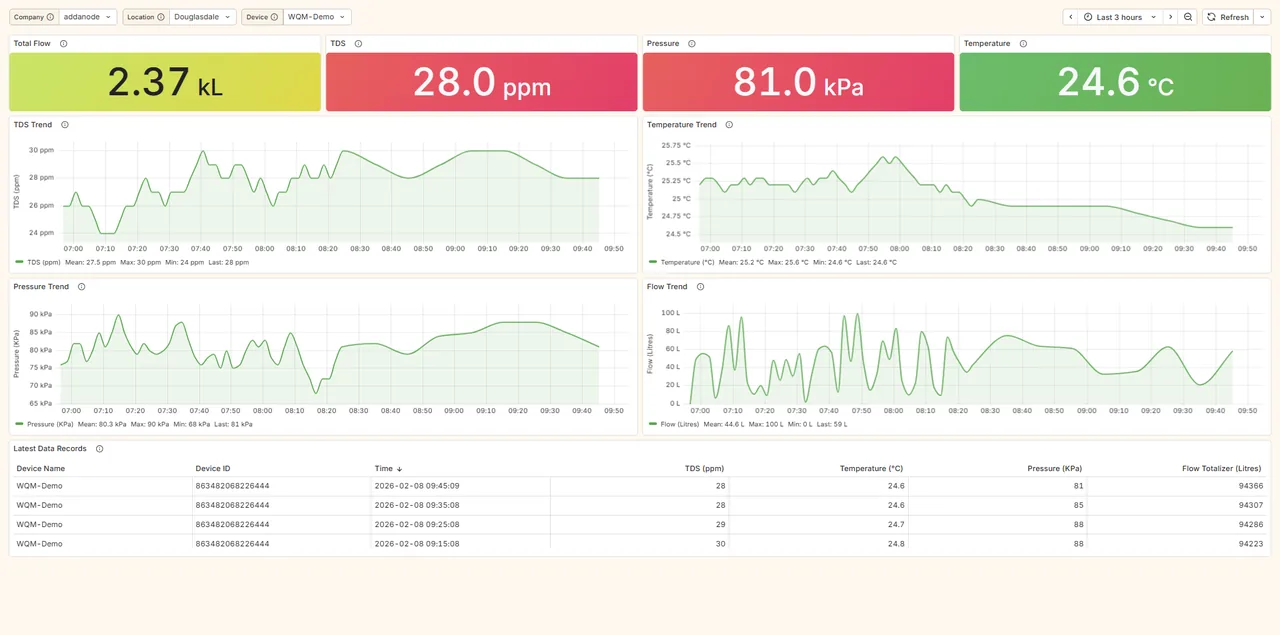
Whether you're a utility chasing non-revenue water, a municipality reporting to the regulator, a mine managing process and discharge water, or a factory monitoring effluent, the questions are the same: how much, what quality, and can you prove it? addanode monitors flow, pressure, level and quality across your network in real time, finds the water you're losing, and automates the compliance reporting DWS and your auditors expect — on infrastructure built for South African power and connectivity.

Who we do this for

One platform, four water problems.

Utilities & municipalities

Cut non-revenue water, protect billing revenue, and run reticulation on live data instead of monthly meter reads. South African municipalities lose a large share of supply to leaks, theft and faulty meters — visibility is the first step to recovering it.

Non-revenue water guide →

Mining & heavy industry

Monitor process water, dewatering, tailings return and discharge — and prove your discharge quality against your water-use licence, continuously, without manual sampling rounds.

DWS compliance guide →

Factories & processors

Track intake, process and effluent quality, catch a breach before it becomes a reportable incident, and turn compliance into a dashboard and an export rather than a monthly scramble.

See a water case study →

Remote & off-grid sites

Boreholes, reservoirs, river gauges and pump stations far from power and signal — monitored on solar and low-power radio, buffering through load shedding so you stop driving out to check.

Solar remote monitoring →
What we monitor

Quantity, quality and compliance — on one platform.

Quantity & flow

Bulk and zone flow, reservoir and tank levels, pressure zones and pump status — the basis for balancing the network and finding losses.

Water quality

pH, turbidity, conductivity, dissolved oxygen, COD, TDS and temperature — for potable, process and effluent water.

Compliance & reporting

Continuous logging and automated reports aligned to DWS effluent and water-use licence conditions — defensible, exportable, audit-ready.

Learn more →

Non-revenue water

District metering areas (DMAs), minimum-night-flow analysis and consumption reconciliation to localise where water — and revenue — is disappearing.

Learn more →

Leak & burst alerts

Sudden flow spikes or pressure drops become an alert in hours, not a problem found weeks later on a flooded road.

Remote & off-grid

Solar-powered, low-power sensing over LoRaWAN / NB-IoT / 4G with edge buffering — so distance and load shedding aren't barriers.

Learn more →
Where it pays back

The water projects we're asked for most.

Recover non-revenue water

Zone the network, rank DMAs by night flow, fix the worst-leaking zone first, then prove the recovery — turning invisible losses into a prioritised work list.

How smart metering cuts losses →

Automate DWS compliance

Log every licence parameter continuously and generate the reports the regulator expects, with alerts before a parameter drifts out of range.

Effluent & DWS compliance →

Assure water quality

Continuous quality sensing with predictive maintenance of filters and instant breach alerts — proven trust, powered by data.

Smart Water Shop case study →

Monitor remote water assets

Boreholes, reservoirs and pump stations that report their own level, flow and status — off-grid on solar, continuous through outages.

Solar-powered monitoring →
How it works

Sensor to dashboard — read what you already have.

1 · Sense

Flow, level, pressure and quality sensors at the points that matter — integrated with your existing meters and instruments, not a rip-and-replace.

2 · Buffer at the edge

Edge devices log locally and sync when power and connectivity return, so a night-flow record is never lost to load shedding.

3 · Visualise & alert

One dashboard for quantity, quality and compliance, with threshold alerts to WhatsApp or email the moment something moves.

4 · Report & act

Automated compliance exports and prioritised leak/quality work lists — data that drives an action, not just a chart.

It all runs on the in-house addaNet platform — so your water data can sit alongside energy, asset and production data in one operational picture.

Why addanode for water in South Africa

Built for our networks, our power, our regulator.

Engineered for the conditions you actually operate in: edge buffering and solar so monitoring survives load shedding and reaches off-grid sites; connectivity matched to the site (LoRaWAN, NB-IoT, 4G); compliance aligned to DWS and water-use licences; and because we build both the hardware and the software in-house and support it locally, we scope for the loss or the licence that matters most — and start where it pays back fastest.

Frequently asked

Water-monitoring questions we answer.

Most water projects are driven by one of two things: a compliance deadline, or water you're losing and can't locate. Here's how we approach both.

Yes. We monitor the parameters in your water-use licence, log them continuously, and generate the reports DWS expects — so compliance is a dashboard and an export, not a monthly scramble. See our guide on effluent monitoring and DWS compliance.
Yes. District metering plus pressure and minimum-night-flow analysis pinpoints where water is being lost across a reticulation network, so you target repairs instead of guessing. Our non-revenue water guide walks through the method, and you don't have to meter every property to start.
Yes. We use low-power sensors with solar where needed, and LoRaWAN, NB-IoT or 4G for connectivity, with local buffering so a dropped signal doesn't lose data — important for reservoirs, boreholes and pump stations in the field. See solar-powered remote monitoring.
Yes. Threshold alerts go to WhatsApp or email the moment a parameter moves out of range, so you can act before a breach becomes a reportable incident.
No. We integrate with the meters, loggers and instruments you already have wherever possible, adding sensing only where there's a gap — the same read-what-you-own approach we take across the addaNet platform.
Yes. Edge devices buffer readings locally and sync when power and connectivity return, so you keep a continuous record across an outage — including the night-flow window that matters most for leak detection.
Related reading

Go deeper on water.

Prove your water numbers — automatically.

Tell us what you need to monitor or report — non-revenue water, effluent compliance, a remote reservoir. We'll scope the sensors, the network and the compliance dashboard, and tell you where to start.