Environmental monitoring that runs all the time — not the morning the inspector arrives.
A grab sample once a month tells you about one minute, on one day. Environmental monitoring on addaNet measures water, air, dust, gas, noise and emissions continuously, turns that into real-time environmental data on one dashboard, and produces the compliance reports DWS, the DMRE and your air-quality licence expect — on infrastructure built for remote South African sites and load shedding.
Environmental, compliance, and monitoring & evaluation are not the same job.
Environmental monitoring
Measuring what's actually happening in the environment — the pH of a stream, the dust at a boundary, the gas in a heading. This is environmental monitoring and assessment: collecting the real-world numbers, continuously, whether or not anyone is watching.
Compliance monitoring
Comparing those numbers against a limit — a DWS water-use licence condition, an air-quality licence, an MHSA exposure threshold. Same sensors, different question: are we inside the line, and can we prove it to the regulator?
Monitoring & evaluation
Stepping back to ask whether a programme is working over time. Monitoring and evaluation (M&E) takes the data trend — is the dust-suppression spend actually cutting fallout? — and turns measurement into a decision. Measure, report, act, repeat.
The short version: environmental monitoring tells you what's happening. Compliance monitoring tells you whether you're inside the licence. Monitoring and evaluation tells you whether the programme is working. The same continuous data feeds all three — which is the whole point of measuring it properly once, rather than chasing three separate sampling rounds.
One platform, four environmental obligations.
Mines & heavy industry
Boundary dust, workplace gas and noise, blast-vibration, tailings seepage and discharge quality — monitored against MHSA exposure limits and air-quality licences, continuously, instead of in quarterly survey rounds.
Occupational hygiene monitoring →Water utilities & processors
Surface water, intake, process and effluent quality measured live and proven against DWS conditions — so a breach is an alert before it's a reportable incident, not a finding in next month's lab report.
Water quality & effluent →Tailings, dams & structures
Phreatic levels, pore pressure, seepage, freeboard and movement on tailings storage facilities and dams — the slow-moving signals that matter long before they become a stability event.
Tailings & dam monitoring →Remote & off-grid sites
Weather stations, river gauges, rehabilitation areas and boundary monitors far from power and signal — running on solar and low-power radio, buffering through load shedding so the record never has a gap.
Solar remote monitoring →Which environmental parameters, and what each one tells you.
| Parameter | What it tells you | Typical use |
|---|---|---|
| pH, conductivity, TDS | Acidity and dissolved-salt load in water — early sign of contamination or process upset | Effluent, surface water, acid-mine-drainage watch |
| Turbidity & suspended solids | How much sediment a discharge is carrying | Discharge quality, settling-pond performance |
| Dissolved oxygen & COD | Organic load and the health of a receiving water body | Wastewater treatment, river compliance |
| PM10 / PM2.5 & dust fallout | Airborne particulate at a boundary or workplace | Air-quality licence, community complaints, dust suppression |
| Gas (CO, CO₂, CH₄, H₂S, SO₂, NOₓ) | Hazardous or regulated gases in air and emissions | Occupational hygiene, stack emissions, landfill |
| Noise (dBA) | Sound pressure at a boundary or workstation | MHSA noise exposure, community noise limits |
| Vibration / blast monitoring | Ground motion from blasting or plant | Structural and community impact assessment |
| Level, seepage & pore pressure | Water inside and behind a structure | Tailings, dams, rehabilitation areas |
| Weather (rain, wind, temp, RH) | Context that explains the readings above | Dust dispersion, evaporation, dam inflow |
Exact sensor selection, ranges and certified methods are confirmed against your licence and site conditions at scoping.
A spot sample is a snapshot. Continuous monitoring is the film.
Most environmental obligations are still met with periodic spot-sampling — someone drives out, takes a grab sample, sends it to a lab, and a report lands weeks later. It's defensible, but it's blind between visits. The breach that happens on a Saturday night, the dust plume on a windy afternoon, the seepage that crept up over a fortnight — none of it is in the monthly snapshot.
- Catch excursions when they happen, not at the next visit
- See trends and drift — the signal evaluation actually needs
- Cut the cost and risk of manual sampling rounds at remote sites
- Keep an unbroken, time-stamped record an auditor can trust
Periodic sampling still has a place. Certified lab methods are the reference for many parameters. Continuous sensing doesn't replace them — it fills the gaps between them and tells you when to take the next sample, so you stop sampling blind.
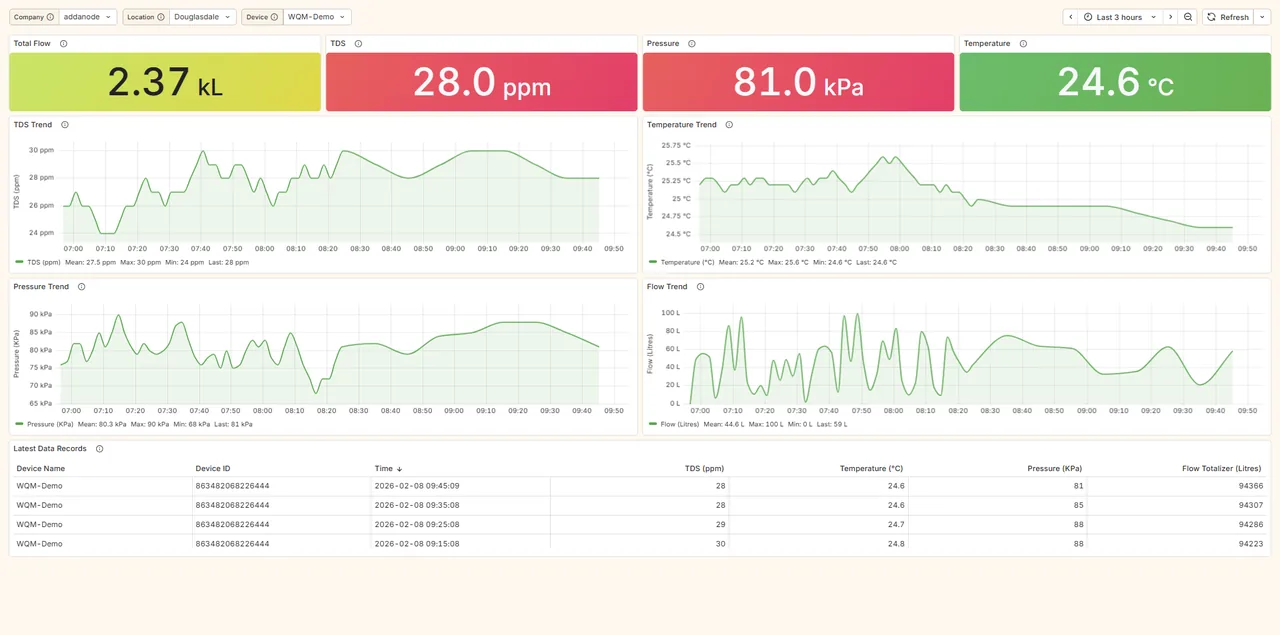
The monitoring-and-evaluation loop — measure, report, act.
1 · Measure
Continuous, time-stamped readings of the parameters that matter — water, air, dust, gas, noise, structures — gathered automatically.
2 · Report
Automated compliance and performance monitoring reports against each licence limit — defensible, exportable, ready for the regulator.
3 · Evaluate
Read the trend, not just the day: is the programme — dust suppression, treatment, rehabilitation — actually moving the numbers?
4 · Act
Alerts and prioritised work lists turn a drift into an intervention before it becomes a breach. Then measure again.
It all runs on the in-house addaNet platform — so your environmental data sits alongside your water, asset and production data in one operational picture, not in a separate silo that only the EM team ever opens.
Compliance monitoring that produces the report the regulator wants.
Against the limit, automatically
Every monitored parameter is compared to its licence condition in real time — DWS effluent and water-use limits, air-quality licence thresholds, MHSA exposure limits.
Regulator-ready exports
Scheduled compliance reports and audit-ready exports formatted for DWS, air-quality and Green/Blue Drop expectations — generated, not assembled by hand the night before.
Alert before breach
Threshold alerts to WhatsApp or email the moment a value approaches a limit, so you act while it's still an internal issue — not a reportable incident.
Emissions monitoring
Stack and fugitive emissions logged continuously against your atmospheric emission licence, with the trend that proves abatement is working.
Defensible record
An unbroken, time-stamped, tamper-evident data trail — the difference between "we believe we complied" and "here is the continuous record".
One source of truth
Environmental, compliance and M&E reporting drawn from the same dataset, so the safety, environmental and operations teams aren't arguing over whose numbers are right.
Monitoring that survives load shedding and reaches where there's no grid.
Environmental monitoring points are rarely next to a plug. Boundary dust monitors, river gauges, tailings instruments, weather stations and rehabilitation-area sensors sit out in the field. addanode runs them on solar with low-power sensing over LoRaWAN or 4G, and buffers readings at the edge so a dropped signal or an outage never punches a hole in the compliance record. When power and connectivity return, the data syncs — including the overnight window you'd otherwise have lost. See our note on solar-powered remote monitoring.
Sensor types and compliance regimes we work to.
Water quality
pHConductivityTurbidityDissolved oxygenCODTDSTemperatureAir, dust & gas
PM10 / PM2.5Dust falloutCO / CO₂CH₄ / H₂SSO₂ / NOₓNoise (dBA)Structures & weather
Level & seepagePore pressureVibration / blastRainfallWindTemp / RHCompliance regimes
DWS water-use licenceMHSAAir-quality licenceGreen / Blue DropEmission licenceConnectivity & power
LoRaWAN4GSolarEdge bufferingOutput
Live dashboardWhatsApp / email alertsScheduled reportsCSV / SQL exportREST / OPC-UASensor types and regimes reflect addaNet's supported capabilities; the exact certified set for your licence is confirmed at scoping.
Go deeper.
Environmental monitoring questions we answer.
Most environmental-monitoring projects start with one driver: a licence to comply with, a complaint to answer, or a programme you need to prove is working. Here's how we think about each.
Prove your environmental numbers — continuously.
Tell us what you need to monitor or report — effluent quality, boundary dust, a tailings facility, an air-quality licence. We'll scope the sensors, the network and the compliance dashboard, and tell you where to start.