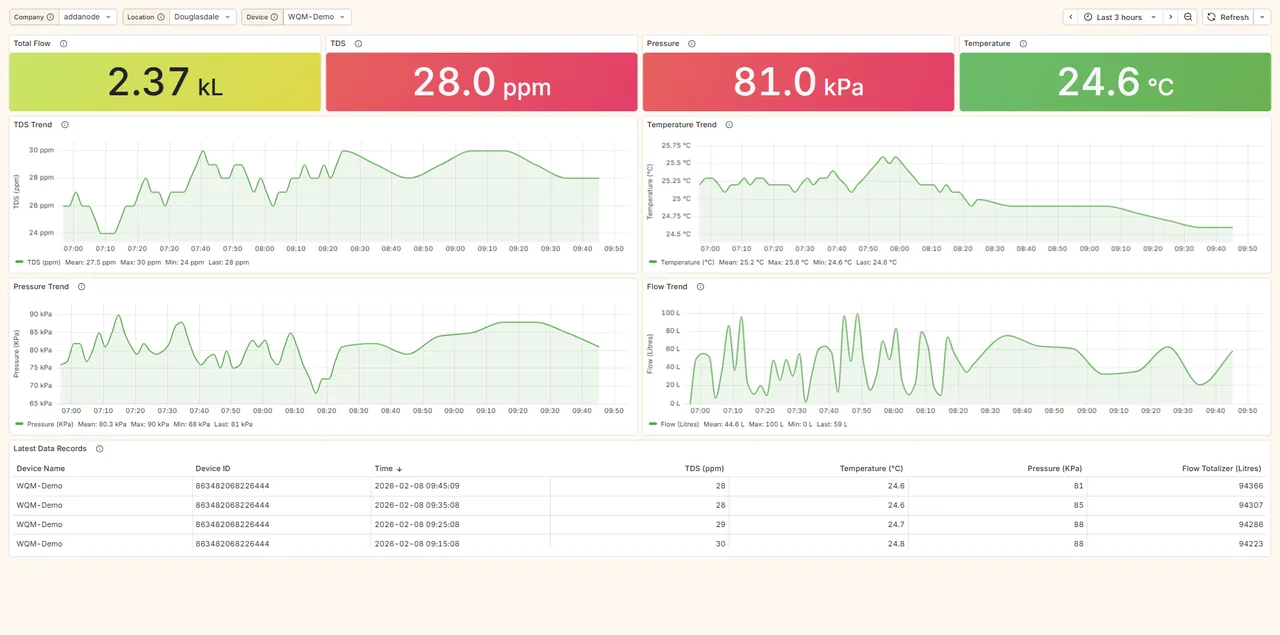
What actually goes wrong in a water shop — and what the system catches.
Water shops fail quality tests for a short list of reasons, and almost none of them appear suddenly. They develop over days or weeks while the morning handheld reading still looks acceptable, which is exactly the gap continuous sensing closes.
| What goes wrong | How you notice | What to do about it |
|---|---|---|
| RO membrane fouling | TDS creeping upward week on week, long before a test is failed | Trend rejection rate rather than the daily number — a membrane degrades over weeks and announces it clearly if anyone is watching |
| Pre-filters left past their life | Pressure drop across the pre-stage rises; membrane life quietly shortens | Change pre-filters on differential pressure, not on the calendar. They exist to protect the expensive stage |
| UV lamp past its rated life but still lit | Nothing visible at all — disinfection weakens silently | Track lamp hours and replace on them. A lamp that lights is not the same as a lamp that disinfects |
| Storage tank or dispensing-point recontamination | Water tests clean at the machine and fails at the tap | Sample after the tank and at the nozzle, not only after the RO. Most failures are found in the last few metres |
| Blending used to stretch the membrane | TDS sits on target while the process behind it drifts | Know and record the bypass ratio; blending hides membrane decline until it cannot |
| Hidden leak under the tank or slab | The water bill climbs while sales stay flat | Reconcile feed flow against dispensed volume daily — the gap is the leak, and it shows up long before the damp does |
| Hose, nozzle and container hygiene | The line passes and a customer’s container does not | Treat the last metre as part of the product, with a cleaning schedule someone can demonstrate |
| No record when an inspector arrives | A well-run shop cannot prove it is well run | Keep the continuous record. A notepad is a claim; a trend with timestamps is evidence |
Two of these account for most failed tests. Recontamination after the treatment train is the first — the machine is doing its job and the tank, hose or the customer’s own container is not, which is why sampling only at the machine gives false comfort. The silent UV lamp is the second: it is the one failure with no symptom at all, no taste, no reading, no pressure change, and the only defence is counting hours.
The commercial point underneath all of it: a shop that can show a month of continuous readings is in a different position from one that cannot — with an inspector, with a customer who asks, and with the wall display that answers the question before anyone has to ask it.